What do notebook games teach?
Boxes teaches planning and sacrifice, Bank builds vocabulary and speed, XO with the eraser teaches thinking ahead, and Column Dash teaches probability.
Paper-and-pen games look simple: dots, lines, a grid. But anyone who has played them a lot knows they teach more than they seem to, without anyone feeling they are studying. That is one of the main reasons we made Yazoodle.
Boxes: planning and sacrifice
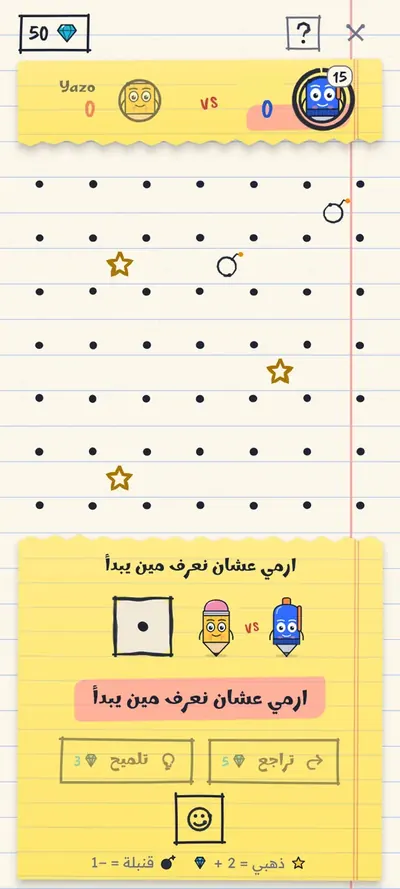
In dots and boxes, the skilled player is not the one who closes the first box. It is the one who knows when to give the opponent two boxes in order to take a whole chain afterwards. The game teaches you to look at the whole page rather than the line in front of you, and that a small sacrifice can win the big prize. In Yazoodle the dice decide how many lines you draw, so you also learn to plan with what you have.
Bank: vocabulary and speed
Name, animal, plant, object, country. The game searches your mind for words starting with one letter, quickly. It builds vocabulary, memory and thinking under time pressure. Played with family, it brings up words and stories nobody expected.
XO with the eraser: thinking ahead
Classic noughts and crosses quickly ends in a draw between two players who know it. When the eraser removes your oldest mark, it becomes a game of memory and planning: you must remember which mark disappears next turn and think one and two moves ahead. The same old game, demanding new thinking.
Sharp Eye: observation
Hunting for words among letters trains the eye to find patterns, to be patient and not give up. The letters left at the end spell a secret word, so there is always a small reward for finishing.
Column Dash: probability
When you pick your numbers from 1 to 6 and let the dice move the pieces, you learn, without noticing, that some outcomes come up more than others and that luck has laws. Over time, players start choosing wisely instead of at random.
And most of all: together
All of these games were made to be played with someone, on one phone, online, or even on real paper. That is what we try to protect: a game as a reason for people to sit together.